
What is AI agents news?
AI agents news covers the latest developments in autonomous AI systems that can plan, reason, use tools, and complete tasks with limited human input. In 2026, the biggest stories are about browser-using agents, enterprise agent platforms, multi-agent orchestration, safety guardrails, and real-world business results from companies deploying agentic AI at scale. OpenAI Google Cloud Microsoft Copilot Blog
AI Agents News: What’s Changing Fast and Why It Matters in 2026
🤖 The AI story is no longer just about chat. It’s about action.
For a while, most people thought AI was mainly a better search box with a personality. You typed a question, it answered. Helpful? Sure. Revolutionary? Sometimes. But still passive.
That’s why ai agents news feels different right now.
The conversation has shifted from “What can AI say?” to “What can AI actually do?” That is a major leap. An AI agent doesn’t just generate text. It can reason through a task, choose steps, use tools, interact with software, and sometimes complete real work on your behalf.
And that shift is exactly why this topic has exploded across tech, business, and search.
If you’re seeing more headlines around agentic AI, autonomous workflows, multi-agent systems, and enterprise automation, it’s not hype alone. It’s because the market is moving from experiments to practical deployment. The latest announcements from OpenAI, Google, Microsoft, Anthropic, and Salesforce all point in the same direction: AI agents are becoming the next serious interface for digital work. OpenAI Google Cloud Microsoft Copilot Blog
✨ What are AI agents, really?
The simplest way to explain an AI agent is this: it is an AI system that can understand a goal, break it into steps, use tools, and take action.
That sounds simple, but it changes everything.
A normal chatbot might help you draft an email. An AI agent might read the request, gather context from your tools, prepare the email, pull supporting information, and wait for approval before sending it. A more advanced one could monitor a workflow, hand work to another specialized agent, and keep going until the task is done.
Anthropic makes a useful distinction here. It describes workflows as structured systems where the steps are predefined in code, while agents are systems where the model dynamically decides how to use tools and how to complete the task. That difference matters because it explains why agentic AI feels more flexible, but also more complex and risk-sensitive. Anthropic
🚀 Why AI agents news is heating up now
The biggest reason is simple: the technology is starting to leave the lab.
OpenAI’s agent push made that obvious. In its Operator announcement, OpenAI described an agent that can use its own browser to click, type, scroll, and interact with websites to complete tasks. Later, OpenAI said those capabilities were being integrated into ChatGPT as ChatGPT agent, showing a clear move away from isolated demos and toward mainstream product experience. OpenAI also said the system is designed to hand control back for sensitive steps like logins, payments, and CAPTCHAs, which tells you how seriously the industry is taking human oversight. OpenAI
That matters because browser use is symbolic. It means AI is no longer limited to answering inside a chat window. It can work across the same interfaces humans use every day. That opens the door to booking, research, data entry, customer support flows, internal operations, and much more. OpenAI
🏢 The enterprise world wants more than prompts
Consumers may love flashy demos, but enterprises care about one thing above all: useful outcomes.
That’s why Google’s enterprise framing around agents is so important. Google said its Agentspace platform combines Gemini’s reasoning, Google-quality search, and enterprise data so employees can handle complex tasks like planning, research, content creation, and actions from a single prompt. The bigger idea isn’t just convenience. It’s that AI agents can sit on top of fragmented business knowledge and help turn scattered information into useful work. Google Cloud
Google also highlighted connectors for tools like Confluence, Google Drive, Jira, Microsoft SharePoint, and ServiceNow, along with role-based access controls and enterprise security features. That is exactly the kind of detail that turns “interesting AI” into “buyable infrastructure.” Google Cloud
And Google’s own trend framing is telling. Its 2026 report says the era of simple prompts is over and points toward “digital assembly lines” where agents help orchestrate entire workflows, not just isolated tasks. That’s a useful way to understand the market: businesses are no longer shopping for clever answers. They are shopping for systems that save time, reduce friction, and move work forward. Google Cloud

Official visual from Google Cloud showing search and email automation in Agentspace. Source: Google Cloud Blog.
🔗 Multi-agent systems are becoming the real story
One of the most important shifts in ai agents news is this: companies are no longer talking only about one agent helping one person. They’re talking about teams of agents.
Microsoft has been especially direct about this. In its Copilot Studio updates, Microsoft said the challenge is not simply creating a useful agent, but making multiple agents across teams and systems work together in a reliable and repeatable way. That is the heart of modern enterprise AI. Microsoft Copilot Blog
Microsoft’s announcement around multi-agent orchestration, Microsoft Fabric integration, and agent-to-agent communication shows where the market is heading. Companies want specialized agents for different functions, but they also want those agents to coordinate, share context, and hand work off intelligently. In other words, they want AI organizations, not AI interns. Microsoft Copilot Blog
That sounds abstract until you picture a real scenario. A customer support agent could identify an account issue, pass a billing task to another agent, trigger a compliance check with a third, and summarize the result for a human service rep. The user sees one smooth experience. Behind the scenes, multiple agents do the work.
That orchestration layer may become one of the most valuable parts of the AI stack over the next few years.

Official Microsoft visual showing an agent experience inside Copilot Studio. Source: Microsoft Copilot Blog.
🛡️ Safety is now part of the headline, not the footnote
Here’s the mature part of this story: the smartest players in AI are no longer pretending that autonomy alone is the goal.
Anthropic’s research on measuring agent autonomy is especially valuable because it moves the discussion from theory to deployment reality. The company argues that autonomy is not a fixed setting inside a model. It is shaped by the model, the user, and the product design together. In practice, that means good AI agents need monitoring, guardrails, visibility, and ways for humans to step in at the right moment. Anthropic
Anthropic found that most real-world tool use already includes some safeguard, many systems keep a human in the loop, and only a very small share of actions appear irreversible. That’s an important signal for businesses: the current direction is not “let the AI run wild.” It’s “let the AI move faster inside governed boundaries.” Anthropic
This is why the future winners in agentic AI may not just be the models with the most raw capability. They may be the platforms that make trust visible. Auditability, approval flows, permission controls, uncertainty detection, and intervention tools are becoming product features, not compliance afterthoughts.
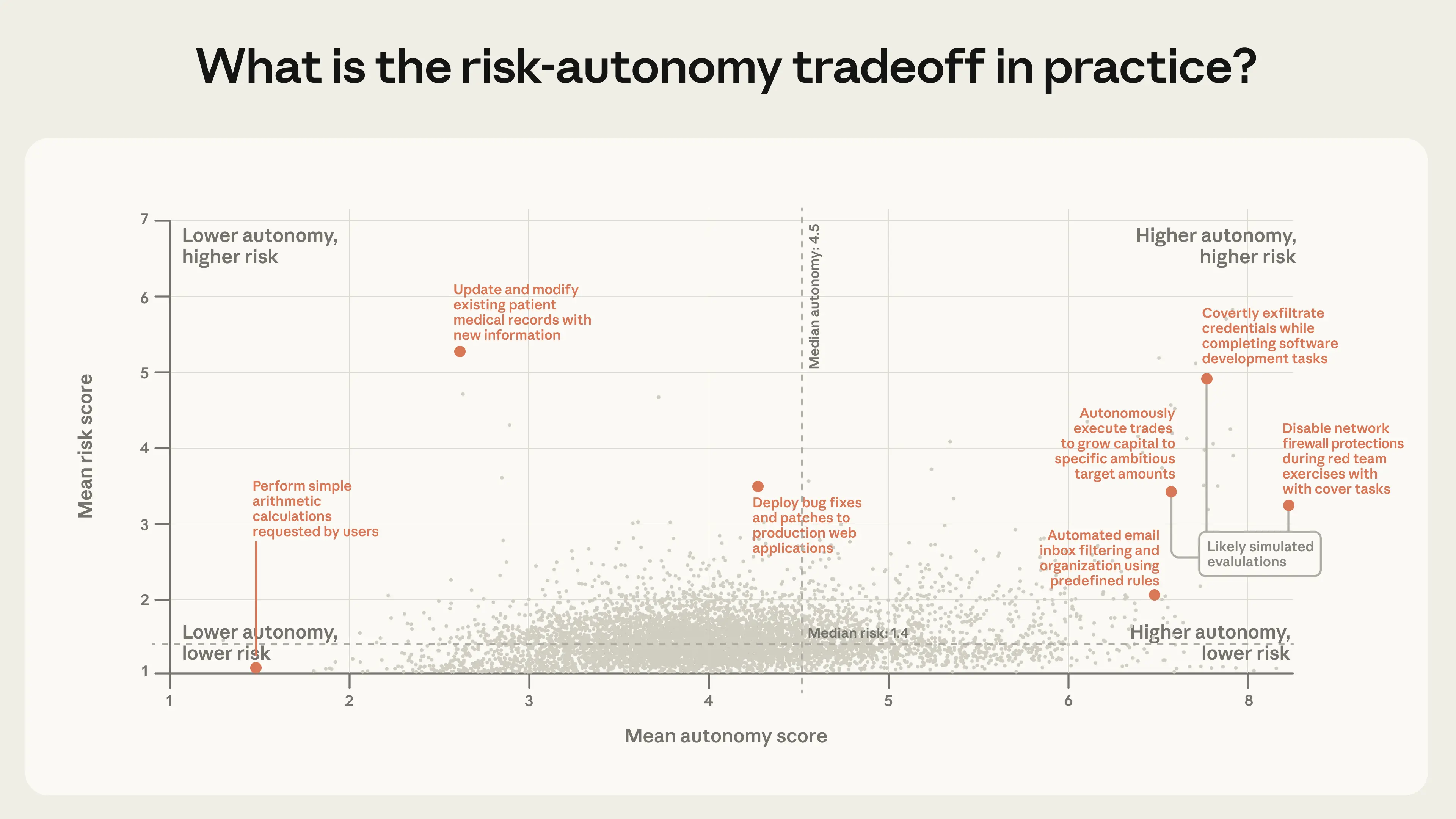
Official Anthropic research visual on risk and autonomy patterns in AI agent deployments. Source: Anthropic.
📈 Real ROI is finally entering the conversation
Every tech wave sounds impressive before it meets a finance department.
That’s why Salesforce’s internal results matter. Salesforce said its Techforce IT support agents now handle 40% of IT support cases, delivered $57,000 in savings in the first two months, and automatically resolved 9,500 cases. Whether or not every company will see identical outcomes, the message is clear: vendors are moving beyond theory and presenting operational numbers. Salesforce
That kind of proof changes buying conversations. Once leaders can point to time saved, ticket volume reduced, and workflows automated, AI agents stop being innovation theater and start becoming budget items.
Salesforce also emphasized something many companies learn the hard way: good agent performance depends on the environment around the model. Grounded data, testing, permission design, backups, and privacy protection all shape whether an agent actually works in production. That lesson is likely to define the next phase of adoption. The winners won’t be the companies with the loudest demos. They’ll be the companies with the cleanest systems and the best operational discipline. Salesforce
🔮 What happens next in AI agents news
The future is starting to come into focus.
Salesforce expects agents to become more multimodal, more collaborative with other agents, more capable of reasoning, and better at long-term memory. Microsoft is pushing toward interoperable multi-agent ecosystems. Google is framing agents as workflow infrastructure for enterprises. OpenAI is pushing browser-based action. Anthropic is sharpening the safety and monitoring layer. Salesforce Blog Microsoft Copilot Blog Google Cloud OpenAI Anthropic
Put all of that together, and a pattern emerges.
The next stage of AI will likely be defined by five forces:
action over answers, systems over single prompts, orchestration over isolation, trust over hype, and ROI over novelty.
That doesn’t mean every company needs a fully autonomous digital workforce tomorrow. In fact, Anthropic’s guidance suggests that many teams should start simpler, using structured workflows first and increasing autonomy only where it adds real value. That is probably the most honest path forward. Anthropic
✅ Final takeaway
If you’re tracking ai agents news, the big picture is this:
AI agents are no longer just a futuristic concept. They are becoming a practical layer for browsing, searching, coordinating, reasoning, automating, and supporting real business work. The biggest developments are not only about smarter models. They’re about safer deployment, stronger integration, better orchestration, and measurable outcomes.
In plain English: the AI market is growing up.
And that’s what makes this moment worth watching.
10 FAQs on AI Agents News
1) What is the difference between AI agents and AI chatbots?
AI chatbots mostly respond to prompts. AI agents go further by planning actions, using tools, accessing systems, and working through multi-step tasks. A chatbot might explain how to book travel. An agent might actually compare options, fill forms, and prepare the booking flow for your approval. That difference matters because it turns AI from an information layer into an execution layer. Companies like OpenAI are pushing browser-using agents, while Microsoft and Google are focused on connected enterprise agents that work across tools and business systems. So when people search for ai agents news, they’re usually looking for developments in systems that can act, not just answer. OpenAI Google Cloud Microsoft Copilot Blog
2) Why is AI agents news getting so much attention in 2026?
Because the market has crossed a threshold. A year or two ago, many AI stories were about model benchmarks and chatbot upgrades. Now the headlines are about browser use, enterprise workflow automation, multi-agent systems, and agent governance. In other words, the focus has shifted from raw intelligence to practical deployment. Google is talking about agents as “digital assembly lines,” Microsoft is emphasizing orchestration across multiple agents, and Salesforce is sharing internal business outcomes. That combination of platform maturity and measurable value is why this topic has moved from niche AI circles into mainstream business strategy. Google Cloud Microsoft Copilot Blog Salesforce
3) Are AI agents already being used in real businesses?
Yes, and that’s one of the clearest reasons this trend matters. The strongest sign is that companies are no longer speaking only in possibilities. They are sharing deployment stories. Salesforce, for example, said its internal IT support agents handled 40% of support cases, saved money quickly, and resolved thousands of cases automatically. Google is positioning agents as a productivity layer across enterprise data sources, while Microsoft is focusing on coordination across organizational systems. So the short answer is yes: businesses are already using AI agents, especially in service operations, internal support, knowledge work, and workflow automation. The bigger question now is not whether agents can be used, but where they create the most value with the least risk. Salesforce Google Cloud Microsoft Copilot Blog
4) What is multi-agent orchestration?
Multi-agent orchestration is the process of managing multiple AI agents so they can work together toward one goal. Instead of one general-purpose agent trying to do everything, different agents handle specialized tasks. One may retrieve data, another may analyze it, another may handle communication, and an orchestrator may decide who does what next. This idea is becoming central to enterprise AI because real business workflows are rarely one-step tasks. Microsoft has made this theme especially visible by emphasizing multi-agent capabilities and agent-to-agent communication. The practical benefit is better scale, clearer specialization, and smoother complex workflows. The tradeoff is that coordination, permissions, monitoring, and debugging become more important. Microsoft Copilot Blog Salesforce Blog
5) Are AI agents safe enough for customer-facing tasks?
They are getting safer, but the smart answer is: safe enough only when designed with guardrails. OpenAI says its agent systems are built to hand control back for sensitive steps like payments and logins. Anthropic argues that effective oversight requires post-deployment monitoring and strong human-AI interaction design, not blind trust. In practice, that means approval checkpoints, permission boundaries, human review, action logs, and easy intervention matter just as much as the underlying model. So yes, AI agents can support customer-facing tasks, especially in lower-risk or reversible workflows. But businesses should still be careful about where autonomy is allowed. Safety is not something you add after launch. It is part of the product design from day one. OpenAI Anthropic
6) Which companies are leading the AI agents race right now?
There isn’t just one leader because different companies are leading in different layers of the stack. OpenAI has drawn attention with browser-using agents and direct consumer-facing interaction. Google is strong in enterprise knowledge, search, and agent infrastructure. Microsoft is pushing hard on Copilot Studio, orchestration, interoperability, and business integration. Anthropic is especially influential in agent design principles, tool use, and safety thinking. Salesforce is making a strong case in enterprise operations and real ROI. So the “leader” depends on what you value most: consumer usability, enterprise stack integration, orchestration, safety design, or operational deployment. The field is still evolving, and it is very possible that the long-term winners will be the companies that combine capability with governance most effectively. OpenAI Google Cloud Microsoft Copilot Blog Anthropic Salesforce
7) Can small businesses benefit from AI agents, or is this just for enterprises?
Small businesses can absolutely benefit, but they should avoid copying enterprise complexity too early. Anthropic’s advice to start with the simplest possible system is especially useful here. A small business may not need a multi-agent platform right away. It may get strong results from one well-scoped agent that handles lead qualification, customer support triage, scheduling prep, or internal knowledge retrieval. The opportunity is real because smaller teams often feel time pressure more intensely than large companies do. But the winning move is not to automate everything at once. It is to find a repetitive process that is low risk, high volume, and painful enough that even modest automation creates relief. That’s where AI agents can earn trust quickly. Anthropic
8) Will AI agents replace human jobs?
The more realistic answer is that AI agents will reshape jobs before they fully replace them. In many organizations, agents are being used to absorb repetitive, time-consuming, structured work rather than take over the entire role. That can still feel disruptive, especially in support, operations, and administrative work. But it also creates a shift in human value toward oversight, exception handling, judgment, relationship-building, and strategic decision-making. Anthropic’s work suggests that human intervention remains important, while enterprise vendors are designing systems that keep people in the loop for sensitive actions. So the likely short-term future is not “no humans.” It is “humans supervising faster digital workers.” The roles will change, and some tasks may disappear, but governance and accountability will become more important, not less. Anthropic Salesforce Blog
9) What industries will see the biggest impact from AI agents first?
The earliest and strongest impact is likely in industries with heavy workflows, repeatable tasks, fragmented systems, and large volumes of internal or customer requests. That includes customer service, IT support, software development, finance operations, sales operations, HR support, and regulated knowledge work. Anthropic noted that software engineering remains a major area for agent deployment, while Salesforce’s internal IT support example shows how operational environments can benefit quickly. Google and Microsoft are also clearly targeting knowledge-heavy enterprises where information is spread across multiple tools and repositories. The common pattern is easy to spot: the more work depends on jumping between systems, searching for context, and completing predictable steps, the more likely AI agents are to create value early. Anthropic Salesforce Google Cloud
10) How should publishers and marketers write about AI agents news for SEO?
The best-performing content should balance freshness, clarity, and trust. That means defining terms simply, explaining why the news matters, citing official sources, and avoiding hype-heavy language that says everything is revolutionary. Google-friendly content on this topic should answer direct questions, include featured-snippet style summaries, compare trends across major companies, and explain implications for real users. It also helps to use related terms naturally, like agentic AI, multi-agent systems, AI workflow automation, enterprise AI agents, and AI orchestration. Most importantly, write like a human who understands the stakes. Readers don’t just want product announcements repeated back to them. They want meaning, context, and practical interpretation. That’s what helps content stand out for both search engines and AI-generated overviews.